A four-step questionnaire returns a tiered menu, and a 3D scene lays out the whole table
Guests booking wedding catering need to confirm the menu and also see how the table will look. Guests describe the event in four steps, receive a tiered menu, and move straight into a 3D scene to lay out the whole table.
The same approach suits caterers, banquet venues, wedding planners, tableware and floral rental, and any service that is understood only once the parts are put together.
Catering guests need to confirm both the menu and the look of the table
Catering guests buy a picture of the whole meal: the food and the look of the table on the day. There are seven services, from Western-style weddings, round-table banquets and first-birthday parties to individual boxed meals, each with its own specifications. Date, headcount, venue and dietary restrictions all change the menu and the price.
When each inquiry is handled by hand, one question and one menu at a time, proposal speed affects how many orders can be taken and how long guests spend comparing prices.
The seven catering services as illustrated cards. One tap moves to the next step.
(Approach)
AI writes the menu, and prices always follow the specification
The biggest risk of putting AI in front of a guest is that it quotes prices on its own. The work is therefore split in two. Pricing method, per-person price and add-on services follow the back-office specification, and the number of dishes is trimmed to the specification limit. AI handles only package names, menus and descriptions, and the back end overwrites any price that differs from the specification.
The dishes AI draws on are filtered first: the season is inferred from the date, indoor or outdoor from the venue, and vegetarian needs from the description. A pool of candidate dishes is then picked from the menu library and handed to AI.
Proposals step up by specification from classic to upgraded to chef's selection, and the system also gives AI past cases with a similar service, price range and headcount for reference.
Desktop recording: choose a service, time, headcount and venue, then type one line of description.
AI writes only the proposal text, and prices are always overwritten by the back-end spec
Guest
Four-step questionnaire
One-line descriptionFor example, many elders or a vegetarian guest
NeedsTiered packages
Development team's service
Candidate dish filterBy season, indoor or outdoor, and vegetarian needs
Spec overridePricing method, price per person, add-ons and the cap on courses
Candidate dishesNames and descriptions
Model provider
Language modelPackage names, menus and descriptions
Not left to the modelPrices, pricing method and the cap on courses.
Scope: proposal generation.
The menu is written by AI, and the price is set by the back-office specification.
Answers are mostly cards and buttons. Available dates come from the system in real time, and a refresh halfway through loses nothing. No registration is needed, and an email check after submitting saves the proposal. The last step takes a single sentence, such as many elderly guests or some vegetarians, and AI adjusts the dishes, reserves vegetarian options and avoids the dietary restrictions mentioned.
Phone view: a description such as many elderly guests, light flavors and 6 vegetarians is typed in, and the page shows that AI is reading the request.
3D table
Guests who chose a Western-style wedding, round-table banquet or buffet confirm a package and carry the order straight into the 3D table. Every table type has built-in seat anchors, so chairs, plates, glassware, napkins and menu cards snap into place. Swapping a square table for a round one rearranges the whole setting automatically.
Square table to round table: every seat rearranges itself around the new anchor points.
Preset packages
Six preset packages apply in one tap, changing furniture, tableware and flowers together. Guests who prefer a custom setting can replace items one by one across ten categories. When the setting is done, the selections are saved to the same order, and the team sees the chosen package and items in the back office.
Desktop
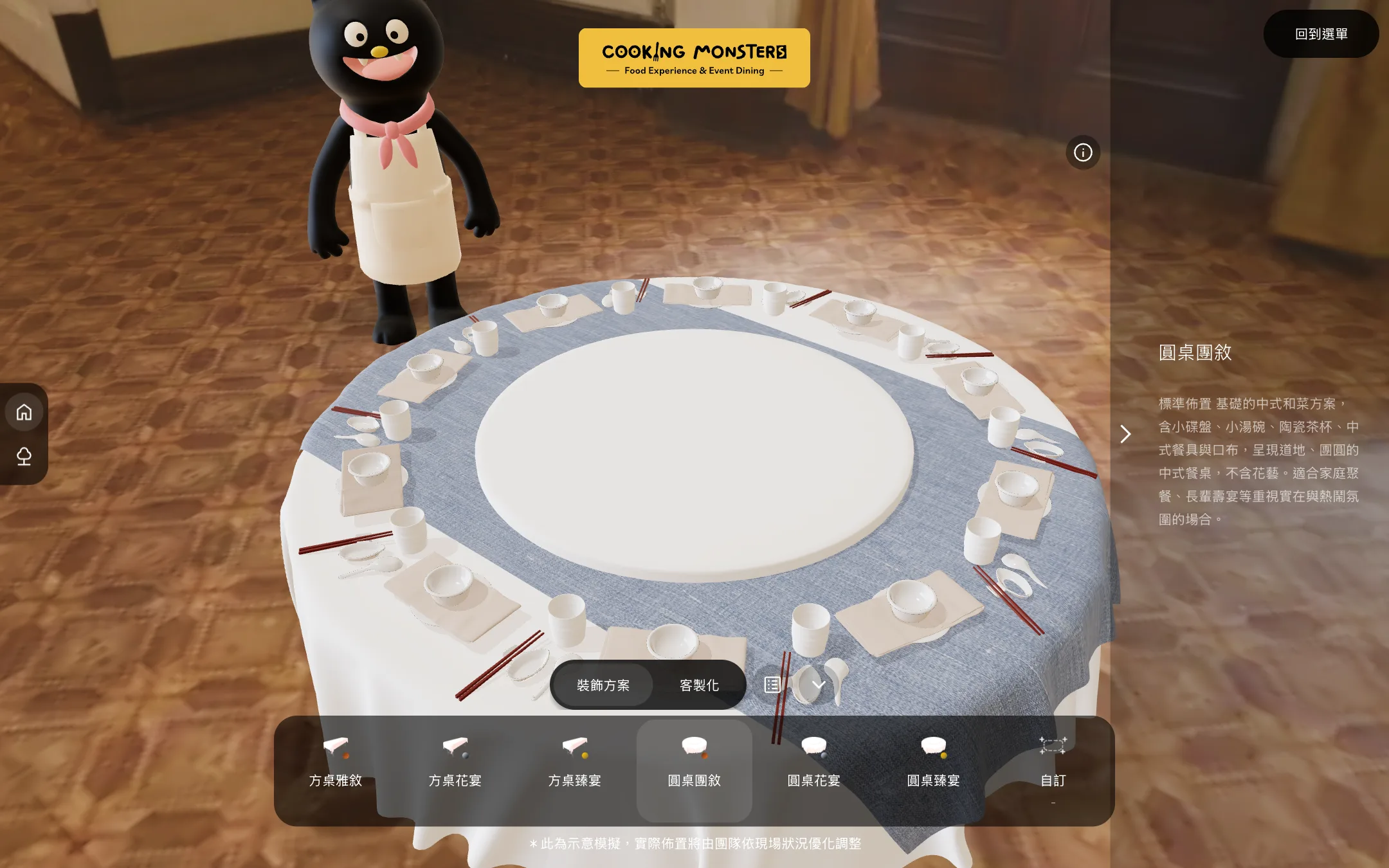
Six preset packages, the whole table swapped at once
Six preset packages, three for square tables and three for round ones, are listed under the 3D table. Selecting one rearranges the whole table, including the table type, chairs, tableware and runner. Switching to customization allows each category to be replaced item by item.
Desktop screen recording: applying the square and round table presets in turn, rotating the view, then switching to customization.
Phone
On a phone, the whole table also changes in one tap
The 3D table on a phone keeps the same presets and the customization tab. One finger rotates the view, and selecting a package rearranges the whole table.
Phone screen recording: rotating the view and applying presets, then switching to customization.
For services that only make sense once assembled, the first meeting can break such a service into a questionnaire and rules.
Two connected websites and an AI that can be tuned
There are now two linked websites and an AI that the team can tune itself. Prompts such as the chef's voice and naming rules are managed in sections in the back office, and every edit keeps a version that can be rolled back. Items and packages are added or removed there too, so a new plate needs no code change.
3D models are compressed and step down automatically on phones, so guests can lay out a table on a phone. Introductions and Q&A are written into the page source, where search and AI engines can read the content.
The 3D scene on the main site, with a round table indoors.Changing the venue moves the same table setting into another scene.
The guest walks from questionnaire to table, and the selections return to the same order
Questionnaire
Proposal
Setup
Confirm
Guest
System
Team
1
GuestFour-step questionnaireAnswered with cards and buttons
2
SystemTiered packages producedFrom Classic and Upgrade to Chef's Selection
3
GuestEnter the 3D tableApply a preset or replace item by item
4
SystemSelections saved to the order
5
TeamTeam views packages and items in the back office
The 3D table suits Western weddings, round-table banquets and buffets.
Services and FAQs come from the back-office database, while the text stays in the page source.
Update frequency and the 3D fallback decide how text gets into the HTML
Content sourceStatic files, or a back-office database
Update frequencyFixed, or frequently updated
When 3D fails to loadWhether users can still read the text
Content is fixed and the number of routes is limited
Build-time prerenderingPOLISH's own site: no framework change, one build step renders each route to static HTML
Content comes from a database and changes often
Server rendering with incremental static regenerationService cards and FAQ are served from the back-office database
3D is the main interface and loading can fail
Server text layer, removed once 3D takes overA public-sector site: text shows only if 3D fails to load or times out
Text is placed only for crawlers and users cannot see it
Prerendering raised the raw HTML of POLISH's home page from 730 bytes to 39,516 bytes with no visible change Related method, figures from another projectPrerendering raised the raw HTML of POLISH's home page from 730 bytes to 39,516 bytes with no visible change
Raw HTML size of the home page (bytes)h1 count in the raw HTML
730 bytes
Before prerendering (single-page app, empty container)Before
0
39,516 bytes
After prerendering (static HTML per route at build time)Adopted
1
POLISH's previous home page. The h1 counts follow the described prerendering approach.
Read the full articleThe three crawler types read the same HTML for different purposes, and robots.txt covers each differently Related methodThe three crawler types read the same HTML for different purposes, and robots.txt covers each differently
Crawlers
Search indexing crawlersOAI-SearchBot, Claude-SearchBot, PerplexityBot: fetch text for search and assistant results
Training crawlersGPTBot, ClaudeBot; Google-Extended is a token with no user agent of its own
User-triggered crawlersChatGPT-User, Claude-User, Perplexity-User: fetch one page only when a user asks
Requests and user agentHTML text
Website (set up by the development team)
Prerendered HTMLThe h1, direct answer, and body text are in the source
robots.txt groupsSearch and assistants open, training by business decision
User agent check at the serverRefuses requests that ignore robots.txt
robots.txt is not access controlRFC 9309 states that its rules are not access authorization; for user-triggered fetches, the official documents say the rules may not apply.
Compiled from the official documentation of OpenAI, Anthropic, Perplexity, and Google, checked on 2026-11-05
With one verification agent per finding, the agent count grows with the findings to 136; batched verification brings it down to about 7 Related method, figures from another projectWith one verification agent per finding, the agent count grows with the findings to 136; batched verification brings it down to about 7
One verification agent per finding136 agentsAgent count scales with findings
Agents removed by mergingCost at about 5% of the originalOne agent verifies 15 to 20 findings
Batched verificationAbout 7 agentsCeiling fixed before dispatch: findings times verifiers
Audit workflow. Costs are converted at list prices, not invoiced.
Read the full articleTurning thinking off cuts writing time to 6 to 17 seconds, but heading success drops from 11/11 to 2/13 Related method, figures from another projectTurning thinking off cuts writing time to 6 to 17 seconds, but heading success drops from 11/11 to 2/13
Writing timeHeading success rate
15 to 75 s
Thinking on, single passKept
11/11
6 to 17 s
Thinking off, single passNot adopted
2/13
Test site, real model, 13 questions. Sentences removed by the validator were 3 times as many with thinking off.
Read the full articleThe most expensive model handles only the hard cases flagged in sampling, not every document in the corpus Related method, figures from another projectThe most expensive model handles only the hard cases flagged in sampling, not every document in the corpus
Tag the full corpusAbout 1,500 documentsOne subtask per document, tagged by Haiku
Documents not sampledValidator onlyAccepted at exit code 0
Risk-based samplingAbout 160 documentsAbout 10%, reviewed by Sonnet
Escalate to Opus9 subtasksOnly flagged hard cases and anything the validator rejects
Subtasks: about 1,600 for Haiku, about 50 for Sonnet, 9 for Opus. Document and subtask counts are approximate.